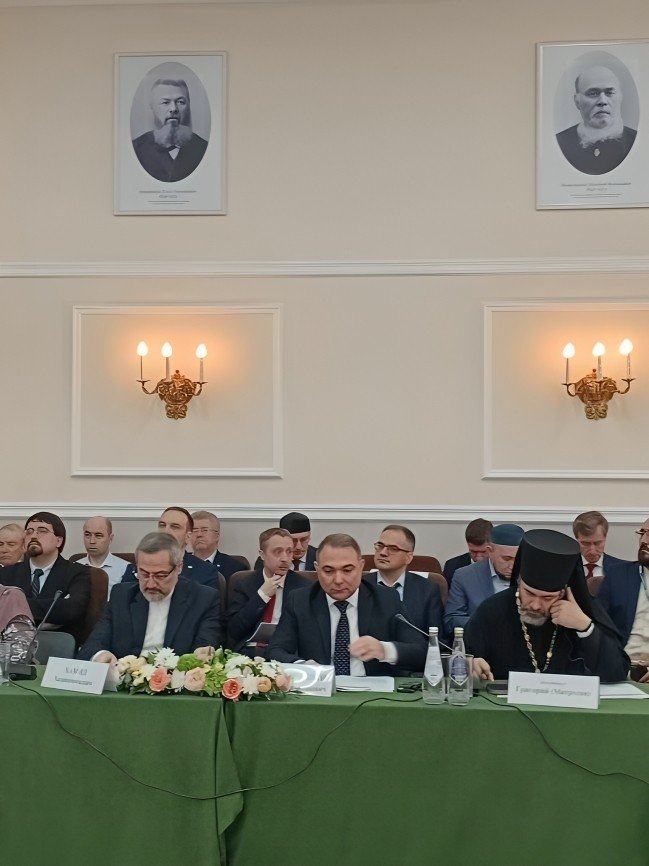
The seventeenth edition of the Russia–Islamic World Forum opened in Kazan, the capital of the Russian Republic of Tatarstan, with the participation of representatives from more than 100 countries and 60 Russian regions, alongside political, religious, cultural, and economic figures from around the world.
Mohamed Nassereldine, President of the Center for International Economic Cooperation with the Countries of the Middle East and North Africa, CIEC-MENA, and President of the Lebanese-Russian Cooperation Office “Roslivan,” participated in the forum and presented his vision for the Greater Eurasian Partnership.
Nassereldine described the partnership as one of the most significant geopolitical and economic transformations in the contemporary international system. He explained that it seeks to reshape cooperation and development on the basis of multipolarity, moving away from unilateral dominance.
He emphasized that the initiative is not limited to economic cooperation. It also represents a strategic and civilizational vision aimed at building a more balanced international order based on respect for cultural identities and the promotion of mutual interests among states.
Nassereldine noted that connecting the Eurasian space with the Islamic world is essential to the success of this project. Islamic countries possess strategic geographical locations, major natural resources, promising markets, and important logistical corridors that play a central role in global trade.
He stated that the Greater Eurasian Partnership could create broad opportunities for cooperation in several sectors, including energy, infrastructure, transportation, technology, food security, and digital transformation.
Such cooperation, he explained, could enable countries that have traditionally remained on the margins of the global economy to become active participants in Eurasian economic integration.
Nassereldine also highlighted the increasing role of regional organizations, particularly the Shanghai Cooperation Organisation and the Eurasian Economic Union. He said their growth could support wider partnerships with the Islamic world and contribute to reshaping international economic cooperation.
From an economic perspective, he described the partnership as an alternative development model based on integration and mutual benefit rather than traditional dependency. He also stressed the importance of increasing the use of national currencies in trade and expanding regional transport and logistics networks.
At the civilizational level, Nassereldine said the success of the partnership requires stronger cultural dialogue and greater intellectual, academic, media, and diplomatic engagement to promote understanding and reduce polarization and confrontation.
He concluded by describing the Greater Eurasian Partnership as a strategic project capable of restoring greater balance to international relations. He added that the participation of the Islamic world reflects an important transformation in its role within the emerging global order and could help build a more equitable and stable framework for regional and international cooperation.